Boxenstopp was born out of the desire to create a convivial space for exchanging and sharing. Sharing of time, space and art, as well as exchanging thoughts, feelings and knowledge. During the first week in July 2022 the exhibition space of the Erkrather Str. 365 in Düsseldorf, Germany turned into a functional house where the artists cohabitated with each other and with their works of art. People were invited to come, share a meal or a drink, enjoy the artworks, weave together, listen to music, play board games, talk with friends or with strangers. Rediscovering the beauty of quotidian activities. This project brought together students from the exchange programs of winter 2021/2022 and summer 2022 of the École des Beaux Arts de Paris and the exchange program summer 2022 of the Kunstakademie Düsseldorf, as well as regular students and alumni of both art academies. Overall there were 26 artists from 15 different countries: In addition to several German cities, the artists come from Iceland, Sweden, UK, Montenegro, Brazil, Peru, Serbia, Israel, Canada, China, South Korea, Colombia, the USA and France. This mix of participants created a very peculiar, temporary ‘melting pot’ of cultures, ideas, and worldviews. The project became a connecting space, a space that builds bridges and crosses boundaries, making place for encounters and dialogue.
The impetus for imagining and creating Boxenstopp came from us, Sofia Magdits and Rosalie Becher, but the working process was collective. Every idea was discussed with all participants, from the preparation and organization of the week, the program, the arrangement of the artworks and pieces of furniture, to the cooking and cleaning duties. An open and experimental approach to exhibition making.
The week developed as followed: During the first three days the artists worked on their pieces and on the creation of the home installation that consisted of house elements (furniture, mattresses, plants, kitchen elements, food) and artworks (sculptures, paintings, installations, videos and sound). We celebrated the opening on the fourth day, with a performance by Arin Ismail and a party on the terrace with music by the DJs Elazer, Yannick and Datscha365. On day five, thanks to the online radio Hallo:Radio based in Hamburg, the artists broadcasted an online radio show from the exhibition space throughout the whole afternoon. On day six, the jazz band Reboot the Mood from Dresden played a concert in the garden, while the artists and visitors enjoyed a barbecue. On the morning of the seventh day, we hosted an open brunch and in the evening, a spontaneous concert by Yvan, Taka and Riad took place. During the whole week, the exhibition space was open to the public and visitors were always welcome. Boxenstopp placed great focus on interaction and provided the opportunity for people from all backgrounds to come together and thereby created situations that engaged all senses.
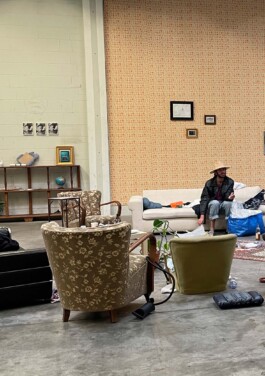
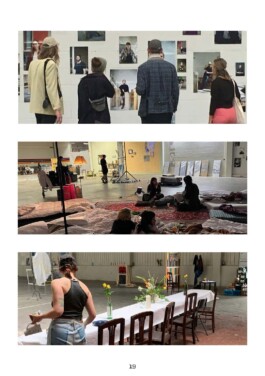
Reflecting about the aspect of space, there are three different spaces to talk about:
1. The physical space on the Erkrather Straße 365, an industrial hall with high ceilings, metal doors, grey floor and without interior walls. It is part of an old car factory and now functions as a shared studio and exhibition space in Düsseldorf.
2. The living space, the house that was created; with a kitchen, a living room, a bedroom, a working space, a video room, a patio and a garden. These areas were divided by the furniture and the artworks, but still remained open spaces without any clear ending or beginning.
3. The exhibition space as a concept, as a place where art encounters a public, as a contact zone, as a social negotiation space, a space of meeting for different people and different thoughts.
4. The virtual space that was created through the radio program and the social media presence on Instagram. The opening night was streamed live and people could comment, react and be present in a non physical way. This shortened the distance between the project and people from other parts of the world.
In relation to the space, the relationship between the private and the public is also an important aspect of the project. In Boxenstopp, the private place of the human being, thehome, is recreated by the participating artists, is shared between them and transformed into a public space. The private becomes public, and at the same time the public becomes private and intimate, both dissolving into one. This dissolved dichotomy is related to another dichotomy.